Lying to the Analyst: Event Log Rendering-Metadata Spoofing
1. Background: How Windows Turns a Number into a Sentence
An event in the Windows event log is not a sentence. On disk, in the EVTX, an event is a numeric EventID, a publisher GUID, a set of binary substitution values, and some metadata (level, keywords, timestamps). The human-readable line an analyst reads in Event Viewer, “An operation was performed on an object”, does not exist in the EVTX at all. It is rendered on demand by joining the numeric event to a message template that lives in a resource DLL on the box.
That join is driven entirely by the registry. Each publisher registers, under HKLM\SOFTWARE\Microsoft\Windows\CurrentVersion\WINEVT\Publishers\{GUID}, a small set of file-path values that tell the rendering code which DLLs hold the templates:
| Value | Holds |
|---|---|
ResourceFileName | event templates (WEVT_TEMPLATE) and, for legacy sources, the message table |
MessageFileName | the message-string table |
ParameterFileName | %%NNNN parameter expansions (access-right names, object types, etc.) |
For the Security channel, the publisher is Microsoft-Windows-Security-Auditing, GUID {54849625-5478-4994-A5BA-3E3B0328C30D}, and on a stock Windows 11 26200 box those values point at:
1
2
3
ResourceFileName  = C:\Windows\System32\adtschema.dll
MessageFileName   = C:\Windows\System32\adtschema.dll
ParameterFileName = C:\Windows\System32\msobjs.dll
So when you open a Security 4662 in Event Viewer, the renderer reads the numeric event from the EVTX, looks up the publisher GUID, opens adtschema.dll to get the template for ID 4662, opens msobjs.dll to expand the %%NNNN access-mask codes into words like WriteDACL, and stitches the final string. The sentence is a function of the registry pointer, not of the log file.
That is the seam. This post is about repointing those values at an attacker-controlled resource DLL so the renderer produces a false sentence for a real event, without altering a single byte of the EVTX.
The ceiling, up front: this needs administrator rights, runs no code in any process, and is not a boundary Microsoft defends, so there is no CVE here. It is a deception primitive, not an exploit. What makes it worth a writeup is that the deception is precise, survives EVTX integrity checks, and reaches whatever consumes the rendered text, your SIEM included.
It is also a post about three things that look like they should work and do not, and I am going to spend as much ink on the falsified claims as on the working one, because the honest boundary is what makes this a usable finding.
2. Four Layers of “Spoofing” and Which One This Is
When someone asks “can a 4662 be spoofed?” the question is underspecified, because there are four distinct layers at which you could intervene, with wildly different feasibility:
| # | Layer | What it controls | Feasible on 26200? |
|---|---|---|---|
| 1 | Generation (kernel SRM → LSASS audit) | the numeric EventID written to the EVTX | No, lives behind the PPL wall (Section 8) |
| 2 | Rendering (publisher metadata → resource DLL) | the human-readable Message the analyst/SIEM sees | Yes, this post |
| 3 | Forging (ETW EventWrite as a provider) | injecting fake events into non-Security channels | Yes, for non-protected channels |
| 4 | Suppression / EVTX edit | removing or altering stored records | Known (auditpol/SACL; SYSTEM service handle) |
This post is layer 2 only, fully reverse-engineered, with two honest boundary results bolted on so it cannot be waved away:
- Layer 1 is a hard wall (the numeric ID is assigned inside PPL-protected
lsass.exe; Section 8). - Layer 2 gives you no code execution: not in the analyst’s process, not in the EventLog service. It is a pure deception primitive (Sections 5 and 6).
If you came here hoping “open the Security log, get popped,” set that expectation down now. That vector is falsified in Section 4, with the import table to prove it. What you get instead is the ability to make the log lie to whoever reads the rendered text, which, given how SIEMs and analysts actually consume logs, is its own problem.
3. The Tamperable Surface: Admin-Writable Render Metadata
The whole technique rests on one ACL fact.
The publisher key for Security-Auditing grants:
1
2
BUILTIN\Administrators   FullControl
NT AUTHORITY\SYSTEM      FullControl
BUILTIN\Administrators has FullControl over the render-metadata key. That means an administrator, or anything that has just won a UAC bypass, can rewrite ResourceFileName, MessageFileName, and ParameterFileName with a plain RegSetValueEx. No TrustedInstaller required.
There is a subtlety worth stating precisely, because it is the difference between “needs TI” and “needs only admin”:
- The files
adtschema.dllandmsobjs.dllare owned byNT SERVICE\TrustedInstaller. Overwriting those files on disk would need TI. - But you are not overwriting the files. You are repointing the registry value at your own DLL sitting somewhere else (say
C:\ProgramData\test.dll). Rewriting the value only needs write access to the key, and Administrators has it.
So the practical vector sidesteps the file ownership entirely. You never touch a TI-owned file, you change where the renderer looks.
And it is not a Security-channel quirk. I sampled the render-metadata ACLs across publishers and 60 of 60 sampled publishers grant Administrators write access to their ResourceFileName/MessageFileName/ParameterFileName. So the writable-metadata precondition is general across essentially the entire Windows telemetry surface (DNS, PowerShell, Sysmon-adjacent providers, anything), not Security-only. The repoint-and-spoof itself then reproduces wherever an event’s description resolves through an RT_MESSAGETABLE, which is the common case; a publisher that renders purely from a WEVT_TEMPLATE with no message-table string would need that template rebuilt, not just a string patched. Security 4662 is just the most legible target to demonstrate it on.
4. The Render Pipeline, Reverse-Engineered (wevtapi.dll 26200)
Before trusting that this is a rendering spoof and not a code-exec primitive, you have to know exactly where the resource DLL gets loaded and by whom. So I walked the render path in wevtapi.dll (the client-side eventing API that eventvwr.exe, Get-WinEvent, and most SIEM agents call) on Windows 11 26200.
The call chain that formats an event’s message string:
1
2
3
4
EvtFormatMessage                         (RVA 0xa100)
  └─ EventRendering::MessageRender        (RVA 0xb728)
       └─ GetRenderedMessageFromService   (RVA 0xd9d0)
            └─ NdrClientCall3(pProxyInfo, procnum 9, …)   ← RPC to the EventLog service
The relevant RVAs in wevtapi.dll 26200:
| Symbol | RVA |
|---|---|
EvtFormatMessage | 0xa100 |
EvtOpenPublisherMetadata | 0x17b0 |
EventRendering::MessageRender | 0xb728 |
GetRenderedMessageFromService (→ NdrClientCall3) | 0xd9d0 |
PublisherMetadataObject::ctor | 0x13ec4 |
GetCachedDescString / SetCachedDescString | 0xdd54 / 0xe244 |
The single most important observation in this whole post is what is missing from wevtapi.dll’s import table:
wevtapi.dllimports noLoadLibrary/LoadLibraryEx. The only module-related imports areGetModuleHandleW,GetModuleHandleExA,GetModuleHandleExW,GetProcAddress, andGetModuleFileNameA. Statically, nothing here maps a module on its own, and the render path goes over RPC instead (next paragraph).
It does import the full RPC client surface: NdrClientCall3, RpcBindingFromStringBindingW, RpcBindingSetAuthInfoExW, and friends. So GetRenderedMessageFromService does exactly what its name says: it bundles the request and ships it over RPC to the EventLog service, and the service does the template resolution. There are two NdrClientCall3 sites in the function: procnum 9 when it is handed an EvtOpenPublisherMetadata handle (the path the Section 7 4624 render takes, and the one that caches its result via SetCachedDescString), and procnum 0xA (decimal 10) as the no-metadata fallback that resolves from the event’s own publisher identity. Either way the resolution happens service-side. There is also a client-side cache (PublisherMetadataObject::GetCachedDescString / SetCachedDescString), but it is populated from the service’s rendered result, and the client never resolves a resource DLL itself.
This kills the first over-claim cleanly. The analyst’s process (eventvwr.exe, the PowerShell running Get-WinEvent, the SIEM agent) cannot be made to execute attacker code by rendering an event, because the DLL that would carry that code is never loaded in that process. It is loaded across an RPC boundary, in the service. The “view-the-log-get-popped” vector is falsified, and the proof is the RPC-delegated render path, corroborated by the missing LoadLibrary import, not a hunch.
5. Where the Resource DLL Actually Loads, and Why It’s Still Not Code Exec
So the load happens in the EventLog service (wevtsvc.dll). The obvious next worry: if the service does a full LoadLibrary of an attacker-controlled ResourceFileName, that is code execution as LOCAL SERVICE inside svchost, which would be a far bigger finding than a rendering spoof.
It does not. I pulled wevtsvc.dll 26200 into IDA and found the load site: LibraryCache::LoadLibraryExW at RVA 0xab530. Its single underlying call is:
1
Library = LoadLibraryExW(ResourceFileName, NULL, 0x60);
The flags are the whole story:
1
2
0x60 = LOAD_LIBRARY_AS_IMAGE_RESOURCE      (0x20)
     | LOAD_LIBRARY_AS_DATAFILE_EXCLUSIVE  (0x40)
That combination maps the DLL as a pure resource/data image. No DllMain runs. No imports are resolved. No TLS callbacks fire. The PE is mapped so the loader can read its .rsrc and nothing else. The service then pulls the templates and parameter strings out of it with FindResourceExW → LoadResource → LockResource. The attacker DLL is consumed strictly as a resource container, a bag of templates, never as executable code.
So code execution is falsified on both sides of the RPC:
| Side | Process | Why no code runs |
|---|---|---|
| Consumer | eventvwr / Get-WinEvent / SIEM agent | wevtapi.dll imports no LoadLibrary, render is RPC-delegated |
| Service | EventLog (wevtsvc.dll in svchost) | loads ResourceFileName with flags 0x60 = data-only, no DllMain |
What survives both falsifications is the deception itself:
- The EventLog service renders using the attacker-controlled
ResourceFileName/ParameterFileName(read as resources). - So the description and parameter strings returned to the analyst/SIEM are attacker-controlled.
- The EVTX numeric
EventIDand the binary substitution data are untouched.
That is the entire finding, stated honestly: you do not run code, and you do not change what the log is; you change what the analyst sees it as.
6. The Mechanism in One Picture
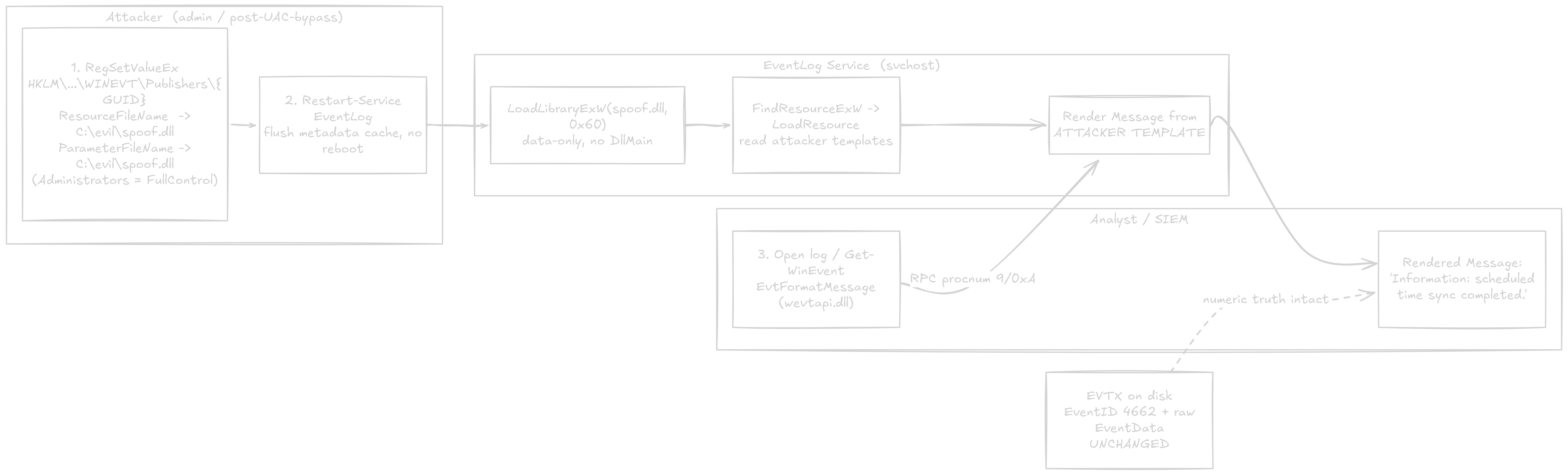
The EVTX bytes never move. Only the registry pointer and a DLL on some other path changed. The renderer faithfully does its job, against attacker-supplied templates.
7. Runtime PoC: The Log Lies, On the Record
I proved the mechanism end-to-end on Windows 11 Pro 26200 on 2026-06-02, using a self-contained legacy Application source rather than the Security channel, for one practical reason: a legacy source lets me carry the whole proof in two tiny message-table DLLs and a PowerShell script, with no dependence on the protected Security pipeline. The mechanism is identical; the one open question was the payload format for a modern manifest publisher, which I work out below, and it turned out simpler than I assumed.
The setup: a legacy source EvtSpoofDemo, and two resource DLLs (real.dll and spoof.dll), both defining the same message id 0x400003E8 (low 16 bits = displayed Event ID 1000, the .mc header that sets Severity=Informational and the language block is elided in the snippets below). The two message tables differ only in text:
real.mc:
1
2
3
4
5
MessageId=1000
SymbolicName=MSG_OP
Language=English
SECURITY ALERT: %1 performed a SENSITIVE operation (%2) on object %3.
.
spoof.mc:
1
2
3
4
5
MessageId=1000
SymbolicName=MSG_OP
Language=English
Information: scheduled time synchronization completed successfully.
.
The PoC registers the source pointing EventMessageFile at real.dll, writes one event with insert strings ("DESKTOP\attacker", "WriteDACL/AllAccess", "lsass.exe"), renders it, then repoints EventMessageFile at spoof.dll, restarts the EventLog service to flush the metadata cache, and re-renders the same on-disk event:
1
2
3
4
5
6
7
8
9
10
11
[3] Render with the REAL message file:
  [BEFORE (real.dll)]
     Rendered Message : SECURITY ALERT: DESKTOP\attacker performed a SENSITIVE operation (WriteDACL/AllAccess) on object lsass.exe.
     .Id (displayed)  : 1000
     EVTX Qualifiers  : 16384
[4] SPOOF: repoint EventMessageFile -> spoof.dll (Administrators-writable; no EVTX change)
[5] Re-render the SAME on-disk event with the spoofed message file:
  [AFTER (spoof.dll)]
     Rendered Message : Information: scheduled time synchronization completed successfully.
     .Id (displayed)  : 1000
     EVTX Qualifiers  : 16384
Same numeric EventID (1000), same Qualifiers (16384), same on-disk record, but a completely different rendered Message. An analyst or a SIEM keying on the description now sees routine time synchronization for an event whose raw substitution data is a privilege operation on lsass.exe.
The flush mechanism is mundane and important: Restart-Service EventLog is enough to make the service honor the new pointer. No reboot. The cache (PublisherMetadataObject::SetCachedDescString on the client; the service’s own LibraryCache) is the only thing keeping the old string alive, and a service restart clears it.
From a legacy source to a real Security event (4624), demonstrated
I first wrote this section as a promissory note: the legacy run is the clean proof, the Security port is mechanical, author a WEVT_TEMPLATE and you are done. Then I went and did the port on a real Security event, and two things came out of it that are worth more than the promise was. It works end to end against a live Security-Auditing event, verified through the exact API Event Viewer uses. And the port is not what I claimed it was, which is the interesting part.
I picked 4624 (“An account was successfully logged on”) rather than 4662, because the most legible lie this primitive can tell is a different user logged in. The New Logon block of a 4624 carries an Account Name, if I can make a real logon render under a name of my choosing while the EVTX still holds the true account, that is the whole thesis in one screenshot.
You do not need to author a WEVT_TEMPLATE. That was the wrong assumption. The description string for a manifest event is a message reference: the compiled manifest points at a message id, and that id resolves into a plain RT_MESSAGETABLE in the resource DLL, the same classic message table a legacy source uses. So to change the rendered description I do not rebuild the template at all. I leave the WEVT_TEMPLATE alone and patch the message-table string it already points at. The 4624 text lives in adtschema.dll’s message table, and in its en-US\adtschema.dll.mui, which on an en-US box is where the localized string actually resolves; both the base table and the MUI can carry the string and which one the loader honors depends on locale, so I patch both in a staged copy and repoint the publisher metadata at that copy, never touching the TI-owned originals in System32. In the message-table string itself the New Logon account name is insertion token %6 and the Subject account name above it is %2 (confirmed against the table, not the rendered layout, which reorders the blocks so Logon Type sits between them). Replace %6 with a literal and every 4624 renders that literal as the account that logged on.
The one non-mechanical thing: Security events are versioned, and the version is in the message id. This is what “straightforward port” was hiding. The same 4624 text is not stored once. It is stored four times in the message table: an un-versioned base id 0x1210 plus three version-stamped ids 0xb0001210, 0xb0011210, and 0xb0021210. The versioned ids follow 0xB0000000 | (version << 16) | 0x1210, so the 0xb00v high word stamps the event version (v0, v1, v2) while the low word keeps the event id, and each copy has a slightly different field layout. The base 0x1210 has no version word at all, which is why it alone lacks the 0xb: it is the un-versioned default string, not version 0 (v0 is 0xb0001210). Windows 11 26200 emits 4624 at version 2, so the renderer resolves 0xb0021210. My first patch hit only the first copy (0x1210), and the live event still rendered the real account, because the event I was staring at resolved to v2, which I had not touched. The fix is to patch every copy. If you take one thing from this section into your own work: when you spoof a Security event’s description, enumerate all message-table ids whose text matches and patch all of them, because the one the box actually emits is the versioned id, not the base.
The patch is length-safe. Each message-table string is rewritten in place and padded back to its original byte length, reusing the existing null terminator, so neither the message table nor the PE resource directory shifts. Two operational details that cost me time and are easy to miss: the EventLog service runs as LOCAL SERVICE, so the staged copy has to be readable by it (icacls <dir> /grant *S-1-1-0:(OI)(CI)(RX), Everyone read+execute, otherwise rendering silently falls back to “The description for Event ID … cannot be found”); and the en-US MUI has to sit next to the DLL or the localized lookup misses. Then repoint ResourceFileName and MessageFileName at the patched copy, Restart-Service EventLog, and it is armed.
I did not eyeball Event Viewer and call it done. I drove the exact wevtapi render that the General tab uses, against a 4624 already sitting in the Security log, reading the now-repointed publisher metadata:
1
2
3
4
EvtQuery(Security, "*[System[(EventID=4624)]]")
  -> EvtNext                          (a real, already-logged 4624)
  -> EvtOpenPublisherMetadata("Microsoft-Windows-Security-Auditing")
  -> EvtFormatMessage(EvtFormatMessageEvent)
Rendered result:
1
2
3
4
5
An account was successfully logged on.
   ...
   Account Name:    DESKTOP-N604E83$     <- Subject   (%2, the REAL caller, untouched)
   Account Name:    POC                  <- New Logon (%6, SPOOFED)
   ...
And here is the same event in Event Viewer’s own General tab, the spoofed publisher metadata resolving live:
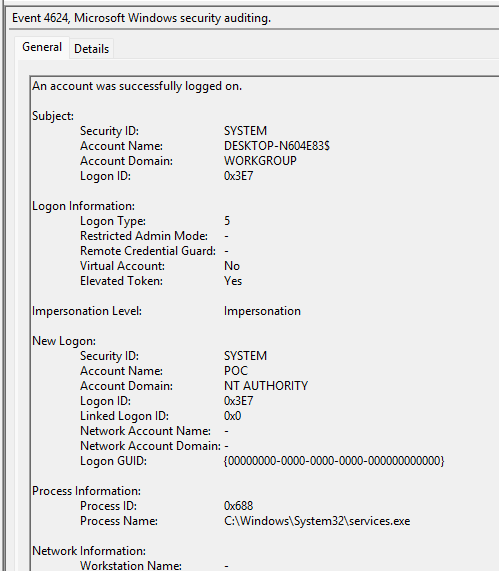 Event Viewer, General tab, a real Security 4624. The Subject Account Name is the true
 DESKTOP-N604E83$; the New Logon Account Name reads POC. Nothing in the EVTX was touched, only the publisher resource pointer.
Same on-disk record, same numeric 4624, and the Details/XML tab still carries the true TargetUserName. The General tab, which is what triage actually reads, says a principal named POC logged on. That is a demonstrated spoof of a real Security event, through the renderer the analyst’s own tools call, not a port I am asking you to take on faith.
One honesty tax specific to this approach: because the spoof is a literal substituted for the %6 token, every 4624 renders POC in the New Logon name while armed. It is a blanket rewrite of the rendered field, not a per-event forgery. Making one chosen logon lie while the rest render truthfully would require conditioning on the substitution data, which the message-table format does not let you do. For an anti-forensics primitive that wants to drown a specific logon in noise, or make the logon history unreadable as a set of names, the blanket rewrite is usually what you wanted anyway.
8. The Wall: You Cannot Change the Numeric ID (Vector 1)
The strongest version of the attack would be to change the number itself: make the generator emit 1000 instead of 4662, so even a raw-XML forwarder is fooled. I chased that (layer 1) and hit a hard wall, and the writeup is more honest for naming it.
RE of lsasrv.dll 26200 plus runtime checks settle it:
- The audit-event generators (
LsapAdtGenerateObjectOperationAuditEventfor 4662 object-operation,LsapAdtGenerateLsaAuditEvent,LsapAdtGenerateDomainPolicyChangeAuditEvent, and the rest) are all delay-load imports fromLSAADT.dll(__imp_load_LsapAdtGenerate*). - The write API
LsapAdtWriteLogis likewise imported from moduleLSAADT. - So the numeric Event-ID assignment and audit-record construction live in
LSAADT.dll, loaded insidelsass.exe.
And on this box, at runtime:
1
2
RunAsPPL     = 2
RunAsPPLBoot = 2
lsass.exe is PPL-protected. OpenProcess(PROCESS_VM_READ) against it is DENIED (error 5). I could not even read it, let alone patch the code/data that stamps the 4662.
So changing the numeric ID at generation requires modifying code or data inside PPL-protected lsass.exe, which (a) loads only Microsoft-signed DLLs under Code Integrity, and (b) exposes no memory writable from userland or even admin. This is the same protection class as credential dumping: it needs a kernel or PPL bypass, and it is out of reach for a userland/admin attacker. Vector 1 is a real wall.
That wall is exactly why layer 2 matters. You cannot change what the log is (PPL-protected generation), but you can change what the analyst and SIEM see it as (Administrators-writable rendering metadata). That asymmetry is the thesis.
9. What This Defeats, and What It Does NOT
Being precise here is the point of the whole finding, so I will draw the line in both directions.
Defeats:
- EVTX file-integrity hashing / WORM archival of raw bytes. The on-disk event is byte-for-byte unchanged; only the registry pointer and an out-of-tree DLL changed. Hashing the EVTX catches nothing.
- Message-based SIEM rules. Any rule, correlation, or alert that keys on the rendered
Messagestring (Get-WinEvent | Where Message -match …, WEF/WEC pipelines that forward rendered descriptions, log shippers that grab the formatted text) consumes the attacker-controlled string. - Human triage. The Event Viewer “General” tab and every console that shows the rendered description show the lie. An analyst skimming descriptions sees routine noise.
- Generality of the precondition. 60/60 sampled publishers grant Administrators write to their render metadata, so the repointability is a property of the telemetry surface, not a Security-channel quirk. The string-level spoof then reproduces wherever the description resolves through an
RT_MESSAGETABLE(the common case); a pure-WEVT_TEMPLATEpublisher with no message-table string would need its template rebuilt rather than a string patched.
Does NOT defeat:
- Raw-XML / numeric-ID forwarding. The
EventIDin the XML is still4662. A pipeline that forwards and alerts on the numeric ID (and the rawEventData), and renders downstream with its own trusted metadata, is not fooled. I am stating this plainly: if your detection keys on the number, this technique does not touch you. - Code execution. It buys none: not in the analyst’s process (Section 4), not in the service (Section 5). It is a deception primitive, full stop.
- The numeric ID at generation. PPL wall (Section 8). The stored
4662stays4662.
The honest one-liner: this makes the rendered story of a real event a lie, while leaving the numeric truth in the EVTX intact. Whether that defeats your detection depends entirely on whether you read the story or the number.
10. Detection
The good news for defenders is that the action is narrow and rare in the wild.
| Indicator | Why it’s suspicious | Telemetry |
|---|---|---|
RegSetValue to HKLM\...\WINEVT\Publishers\*\(ResourceFileName \| MessageFileName \| ParameterFileName) | Legitimately written only by installers; an interactive/runtime change is anomalous | Registry auditing (SACL) / EDR registry sink |
A publisher resource path pointing outside %SystemRoot%\System32 | Stock publishers all live in System32 | Registry value inspection / config baselining |
| A publisher resource path pointing at a non-TI-owned file | Stock resource DLLs are TrustedInstaller-owned | File-ownership check on the pointed path |
Restart-Service EventLog / EventLog stop-start outside patching windows | Required to flush the metadata cache | Service-control (7035/7036) + process telemetry |
Rendered Message diverging from an independent render of the same numeric ID | Direct evidence of the spoof | SIEM-side comparison |
The single highest-value control is the last one: render at the SIEM from a trusted, pinned copy of the publisher metadata, and compare against the endpoint’s rendered string. Divergence is the spoof. Equivalently, forward raw EVTX/XML (numeric EventID + EventData), never the endpoint-rendered Message, which sidesteps the entire technique because you stop trusting the box’s rendering at all.
Note one thing the renderer denies the attacker on the defense side: because wevtapi does the render over RPC and the service loads the DLL 0x60 data-only, there is no LoadLibrary of the spoof DLL in the analyst’s process to catch; the load is in svchost, as a data file. So image-load telemetry on the analyst host will not flag the spoof DLL. Watch the registry write and the service restart, not an image load.
11. Mitigations
The honest starting point: this needs Administrator, and “an admin can tamper with the local machine” is not a boundary Microsoft commits to defending. An admin repointing their own box’s logging metadata sits in the same non-boundary as clearing the log or stopping the EventLog service, so there is no MSRC-class bug here and no vendor patch to wait for. The controls that matter are defender-side, and they all reduce to one idea: stop trusting the endpoint’s own rendering.
- Forward raw, render trusted. Forward the numeric
EventIDand the rawEventData, and render at a trusted collector with pinned publisher metadata (see Section 10). The box’s rendering metadata never enters your detection path, which sidesteps the technique outright. This is the one control that actually defeats it. - Monitor the pointers. Put an audit SACL on the
HKLM\...\WINEVT\Publishers\*render-metadata values and alert on any write; installers write them, so a runtime change is the attack. Pair it with the divergence check from Section 10 (the endpoint’s rendered string versus an independent render of the same numeric ID).
For completeness, not as an expectation: Microsoft could tighten the key so Administrators cannot repoint it, or make the service refuse a ResourceFileName that is not a Microsoft-signed binary under System32. I would not bank on either. The first is weak because an admin can take ownership of the key and re-grant write; the second would break every third-party publisher that legitimately ships its own resource DLL outside System32, Sysmon included. The defender-side controls above are the real answer, precisely because the registry pointer is not a boundary you can expect the platform to defend for you.
12. Conclusion
Windows event descriptions are computed, not stored. The number 4662 lives in the EVTX behind a PPL wall you cannot move; the sentence “sensitive operation on lsass.exe” lives behind an Administrators-writable registry pointer you can. Repoint that pointer at your own resource DLL, restart the EventLog service, and every consumer that reads the rendered description (Event Viewer, message-matching SIEM rules, human triage) reads your story instead of the real one, while the EVTX bytes and integrity hashes stay pristine.
I want to be equally clear about the ceiling. You get no code execution anywhere: wevtapi.dll imports no LoadLibrary, so the analyst’s process is inert at render time. wevtsvc.dll loads the resource DLL with flags 0x60, so the service treats it as a data file with no DllMain. And you cannot change the number: generation happens in LSAADT.dll inside PPL-protected lsass.exe, the same wall that stops credential dumping. A raw-XML, numeric-ID forwarding pipeline is untouched by this.
What is left is still a real primitive, and it is now demonstrated on a real Security event rather than argued by analogy: in the common case where detection and triage consume the rendered message, an admin-level attacker can make the security log narrate a lie about a real, on-disk, correctly-numbered event, and defeat both file-integrity hashing and message-based alerting in the process. The 4624 run in Section 7 makes a genuine logon render under an attacker-chosen account name through the same renderer the analyst’s own tools call. The defensive lesson is one sentence: forward the number, not the sentence, and render it somewhere you trust.
Attribution & Status
- All RVAs (
wevtapi.dllandwevtsvc.dll26200), the import-table observation (noLoadLibraryinwevtapi), the0x60load-flag atwevtsvc!LibraryCache::LoadLibraryExW0xab530, the two render RPC procnums inGetRenderedMessageFromService(9for the publisher-metadata path the demo uses,0xA/10 for the no-metadata fallback), and the LSASS/LSAADT generation findings were reverse-engineered on Windows 11 Pro 26200. The publisher GUID{54849625-5478-4994-A5BA-3E3B0328C30D}and theadtschema.dll/msobjs.dllmappings are the as-shipped 26200 values. - Proven (legacy source): the end-to-end rendering spoof on a legacy Application source (2026-06-02), with the before/after rendered strings in Section 7 captured from that run; the Administrators=FullControl ACL on the publisher key; the 60/60 sampled-publisher repointability; the falsification of code execution on both the consumer and service sides; and the PPL wall on vector 1 (
OpenProcess(VM_READ)onlsassdenied, error 5, withRunAsPPL=2). - Proven (real Security event, 2026-06-08): a spoofed Security 4624, demonstrated end to end on Windows 11 26200. The New Logon
Account Namerenders as an attacker-chosen literal (POC) while the Subject account, the numeric EventID, and the Details/XMLTargetUserNamestay real. Verified not by eyeballing Event Viewer but by driving the samewevtapipath it uses (EvtQuery→EvtNext→EvtOpenPublisherMetadata("Microsoft-Windows-Security-Auditing")→EvtFormatMessage(EvtFormatMessageEvent)) against a live 4624, reading the repointed publisher metadata. This also corrected the earlier assumption that a manifest port needs a hand-authored WEVT_TEMPLATE: the description resolves from theRT_MESSAGETABLEthe template already references, so patching the message-table string in a staged copy ofadtschema.dlland itsen-USMUI, then repointing the publisher metadata at that copy, is sufficient. The non-obvious cost was event versioning: the same text lives at four message ids (0x1210,0xb0001210,0xb0011210,0xb0021210) and Windows 11 emits version 2 (0xb0021210), so all copies must be patched. - Not separately shown: a spoofed 4662 specifically. It uses the identical message-table mechanism as the demonstrated 4624; I demonstrated 4624 because a spoofed logon account is the more legible result, and did not also screenshot 4662.
- Falsified (and presented as such): code execution in the analyst’s
eventvwr/Get-WinEvent/SIEM process; code execution in the EventLog service; and any change to the numericEventIDat generation.